Cherrybrook Tile Roofing
Cherrybrook Tile Roofing
Cherrybrook’s established homes, large blocks, and mature tree canopy make it one of the highest-demand areas for tile roof maintenance work in The Hills District. If your home was built in the 1980s or 1990s — and most Cherrybrook homes were — the original cement mortar on your ridge and hip tiles is now 30 to 40 years old. In most cases, it needs replacing.
Hills District Tile Roofing specialises in exactly the work Cherrybrook homes need most: re-pointing, restoration, and the careful tile repair work that older terracotta roofs require.
Call (02) 5700 2003 for a free inspection.
Cherrybrook Homes and Their Roofs
Cherrybrook is one of the most established and distinctive suburbs in The Hills District — and its roofing profile reflects that.
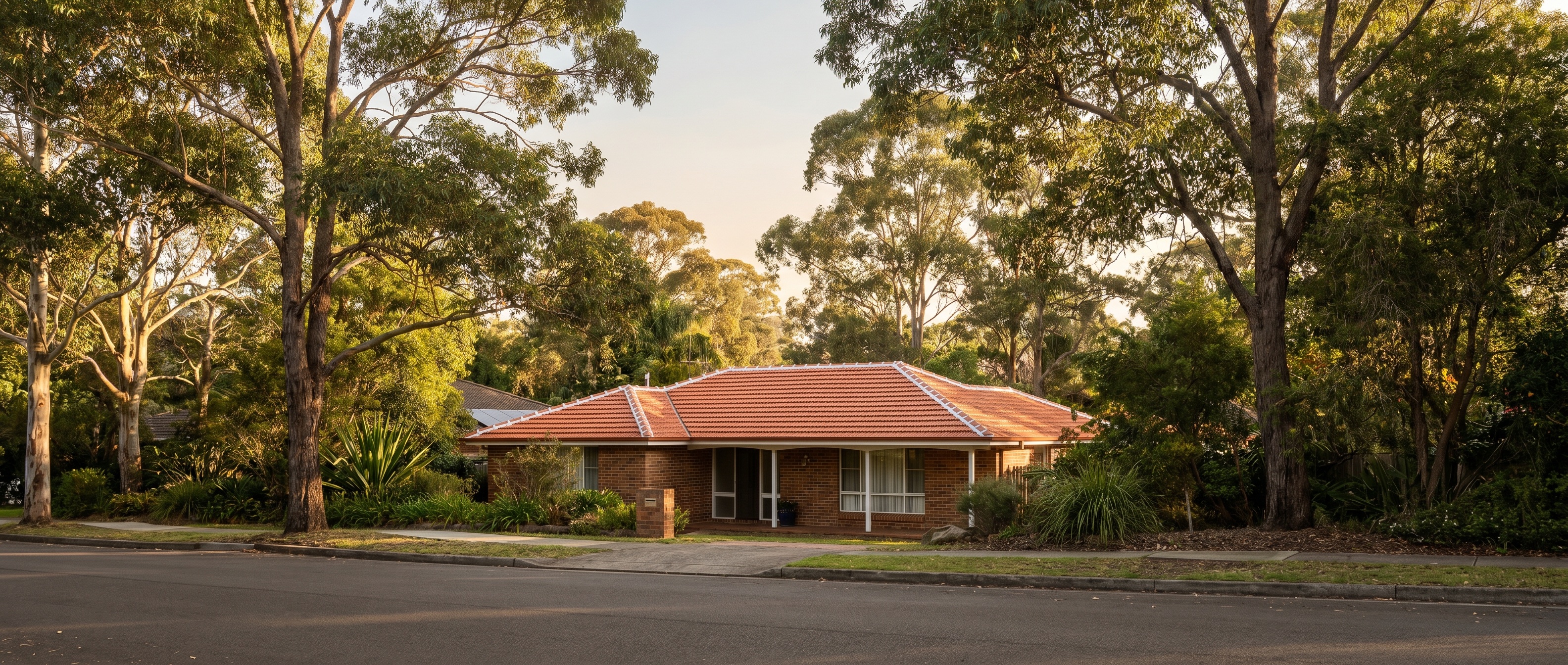
Development in Cherrybrook was concentrated through the 1980s and into the 1990s, and the suburb retains that character today: large homes on generous blocks, wide tree-lined streets, and a predominantly well-presented residential aesthetic. Streets like County Drive, Quarter Sessions Road, New Line Road, and the estates running off Shepherds Drive typify the Cherrybrook housing stock — substantial homes, often two-storey, with original terracotta tile roofs from the Monier and Bristile ranges common in that era.
The Cherrybrook Metro station opened in 2024, significantly improving the suburb’s public transport accessibility and adding to already strong property values. Renewed buyer interest in the suburb has meant more pre-purchase inspections, more renovation projects, and more homeowners assessing deferred maintenance — including roofs that have been quietly ageing for 35 years.
What does a 35-40 year old terracotta roof in Cherrybrook actually look like?
The tiles themselves — if they’re original Monier or Bristile terracotta — are generally still structurally sound. Terracotta is fired clay; it doesn’t degrade the way concrete does, and a well-made terracotta tile from the 1980s has plenty of life left. What has not lasted as well is the cement mortar bedding and pointing the ridge caps, hip tiles, and valley work. That mortar — typically a plain sand-and-cement mix with no polymer additive — has a service life of 25–35 years. For most Cherrybrook homes, it’s now at or past that point.
The other characteristic of Cherrybrook roofs: complexity. Cherrybrook homes from this era frequently feature hip-and-valley rooflines — multiple intersecting planes, hips on all corners, and valley channels where two roof planes meet. This is more architecturally interesting than a simple gabled roof, but it means significantly more mortar work, more valley flashing, and more potential failure points as the roof ages.
Why Cherrybrook Roofs Need More Attention
Large trees — significant debris accumulation Cherrybrook has exceptional tree coverage — mature gum trees, angophoras, and other natives that give the suburb its bushland feel. For roofing, this translates to ongoing leaf and bark debris accumulation in gutters and valleys. Blocked valleys trap water, which wicks back under tile edges and eventually through to the ceiling. Gutters blocked with gum leaves overflow and cause fascia and soffit damage. Cherrybrook roofs need more frequent gutter maintenance than newer, open suburbs.
Original cement mortar now at end of life As noted above, the sand-and-cement mortar from 1980s–1990s builds is at or past its service life. In Cherrybrook, we consistently find homes where the ridge mortar is fully carbonated — still hard to the touch but with zero adhesion. A tap test reveals the hollow sound. The tiles are sitting loose. This isn’t a cosmetic issue — a loose ridge cap in a wind event becomes a falling hazard and an immediate water entry point.
Complex hip-and-valley rooflines mean more mortar joints A simple gabled roof has two ridge lines and minimal hip work. A typical Cherrybrook home with a full hip roof has ridge work along every plane, hip mortar at every corner, and valley channels at every internal corner. That’s potentially three to four times the mortar work of a simpler roof. When mortar fails on a complex roofline, the work involved in full re-pointing is considerable — and it needs to be done by someone who knows what they’re doing.
North-facing pitches and shade — lichen and moss Cherrybrook’s tree canopy means many roofs have patches of shade that promote lichen and moss growth, particularly on south and east-facing pitches. Lichen is tenacious — it grips into the surface of terracotta tiles and holds moisture against them. Left long-term, it can cause micro-fracturing of the tile surface. Restoration treatment addresses this.
Tile Roofing Contractors — Re-Pointing in Cherrybrook
Re-pointing is the single most common and most needed service we perform on Cherrybrook homes. It’s the targeted replacement of failed ridge cap and hip tile mortar — without the need to replace tiles or do a full restoration.
Our re-pointing process:
-
Removal of all existing mortar — we grind or chip out all failed mortar from every ridge cap and hip tile on the roof. We don’t point over old mortar. Old mortar is removed entirely.
-
Inspection of the mortar bed — once old mortar is removed, we inspect the underlying bed and the tiles for any damage or movement. Any displaced tiles are re-seated at this stage.
-
New polymer-modified mortar bed — we install a new mortar bed using a polymer-modified mix that has far greater flexibility and adhesion than the original sand-and-cement. It accommodates thermal movement (the daily expansion and contraction that cracks rigid old mortar) without failing.
-
Colour-matched pointing compound — the pointing (the visible outer coat of mortar) is applied in a colour that matches your tiles. This is an acrylic-based modern compound that’s UV-stable and weather-resistant.
-
Final inspection — every ridge cap and hip tile is tap-tested again to confirm adhesion before we’re done.
A properly done re-point on a Cherrybrook home — using modern materials and correct preparation — should last 20 years or more.
Roof Restoration in Cherrybrook
For Cherrybrook homes where the roof needs more than just re-pointing — where the tiles have significant lichen growth, surface weathering, or a faded appearance — a full restoration is the appropriate treatment.
Restoration includes:
- High-pressure clean — removing all lichen, moss, dirt, and biological growth from tile surfaces
- Full re-point — as described above
- Surface treatment — application of a tile primer and restoration coating that restores the waterproofing properties of the tile surface and refreshes the appearance
A restored 1980s terracotta roof looks markedly better than an untreated one and performs significantly better. The surface coating reduces water absorption, inhibits lichen regrowth, and adds to the visual appeal of the property — relevant for Cherrybrook homeowners who’ve invested in the suburb’s premium aesthetic.
We assess each roof individually. Not every Cherrybrook home needs full restoration — some need only re-pointing. We’ll tell you honestly which applies to yours.
Tile Roof Repair & Restoration Services in Cherrybrook
Roof Re-Pointing — Hills District The standalone re-pointing service — ridge caps and hip tiles only. The targeted fix when tiles are in good condition but mortar has failed.
Tile Roof Repairs — Hills District For broken tiles, valley flashing replacement, and localised repairs. Cherrybrook terracotta tiles can crack from branch strikes and occasional hail.
Tile Roof Restoration — Hills District Full restoration service for Cherrybrook homes ready for comprehensive treatment.
Gutter Maintenance Given Cherrybrook’s tree coverage, we strongly recommend annual gutter cleanouts as part of roof maintenance. We clear gutters, downpipes, and valley debris as a standalone service or in conjunction with roofing work.
Roof Inspections Pre-purchase, post-storm, or maintenance inspection. Written report with photos — useful for the Cherrybrook property market given the suburb’s active buyer interest following the Metro opening.
Areas We Serve in Cherrybrook
We cover all of Cherrybrook, including:
- County Drive and surrounding streets
- Quarter Sessions Road precinct
- New Line Road corridor
- Shepherds Drive and the estates running off it
- The established streets between New Line Road and Pennant Hills Road
- Properties adjoining Cherrybrook Regional Park and surrounding bushland
What Cherrybrook Homeowners Say
“Our 1987 home had the original mortar on the ridge — never been touched in nearly 40 years. Hills District Tile Roofing came out, inspected it properly, showed us photos of what was hollow, and did the full re-point. Excellent work, crew knew exactly what they were doing, and the ridge looks better than it has in years.” — B. Fairweather, Cherrybrook
“We had a significant lichen problem on the back slope of the roof — shaded by a large gum tree for years. They cleaned it, re-pointed everything, and applied a restoration coating. The difference is remarkable. And they cleaned out the gutters at the same time which were absolutely full of gum leaves. Would recommend without hesitation.” — K. Sousa, Cherrybrook
Book Your Free Cherrybrook Roof Inspection
Call (02) 5700 2003 for a free inspection and honest assessment. We’ll inspect on the roof — not just from the ground — and give you a written report with photos and a fixed-price quote for any work needed.
Frequently Asked Questions — Cherrybrook Tile Roofing
My Cherrybrook home was built in 1988. The terracotta tiles look fine but I’ve never had the mortar replaced. Should I be concerned? Yes — this is exactly the scenario that warrants an inspection. Sand-and-cement mortar from 1988 is now nearly 40 years old, well past its typical service life of 25–35 years. Even if the tiles themselves look fine and you haven’t had leaks, the mortar on the ridge caps and hips may have lost adhesion entirely — it fails silently. A wind event can dislodge a loose ridge cap, and then you have an immediate leak and a potential falling hazard. The inspection is free; the peace of mind is worth it.
What are the signs that my Cherrybrook roof needs re-pointing? Visible cracking or gaps along the mortar line of ridge caps, chips of grey mortar in your gutters after rain, a hollow sound when ridge tiles are tapped, or (worst case) visible movement in ridge tiles when touched. From the ground, it’s often hard to assess — a professional inspection is the reliable approach. We do a tap test on every ridge cap and hip tile as part of any inspection.
Can lichen damage terracotta tiles permanently? Long-term lichen growth can cause micro-fracturing of the tile surface — the root systems of lichen penetrate microscopic pores in the tile surface. For tiles that have had heavy lichen coverage for many years, there can be some surface degradation. However, in most Cherrybrook cases, the tiles beneath the lichen are structurally sound. Once lichen is removed and a restoration coating applied, the tile is protected from further growth. We’ll let you know if we see any tiles that have been damaged to the point of needing replacement.
How often should I clean my gutters in Cherrybrook? Given Cherrybrook’s large mature gum trees — angophoras particularly — we recommend gutter cleaning at least once a year, ideally twice: once in autumn (after leaf fall) and once in late spring. After a major wind event that brings down a lot of bark and leaf debris, an additional clean-out is worthwhile. Blocked gutters on Cherrybrook homes cause fascia damage, waterproofing failure at the eave, and water ingress through the roof space.
We’re selling our Cherrybrook home — do we need the roof done before listing? Not necessarily, but a roof in poor condition will appear on a building inspection report and can affect buyer confidence and negotiating position. Our recommendation: have us inspect the roof before listing. If there are significant issues (loose ridge caps, major mortar failure), addressing them before sale protects your price and avoids a nasty surprise on the building inspection. If the roof is fundamentally sound with only minor maintenance needed, a pre-sale roof report showing that can actually be a positive in your marketing.