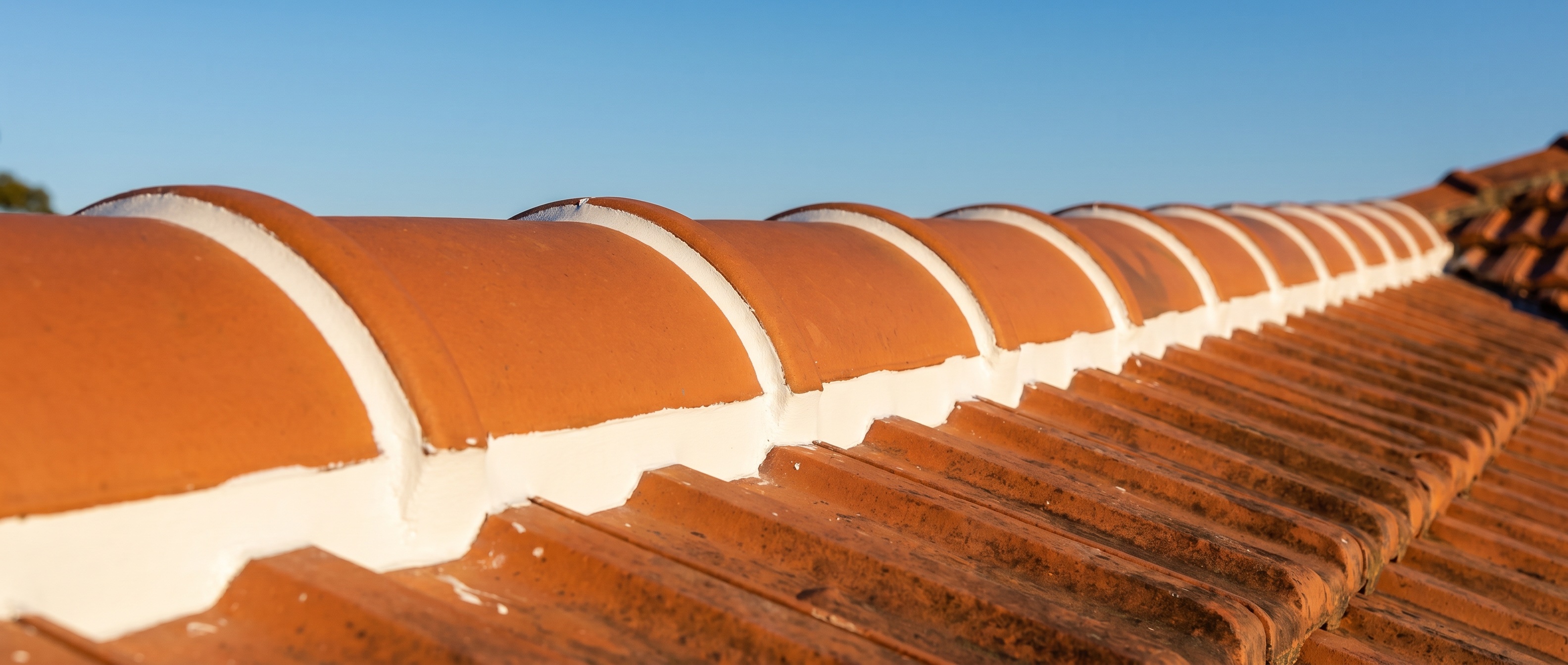
Hills District Roof Re-Pointing
Hills District Roof Re-Pointing
The number one cause of tile roof leaks in The Hills District is not broken tiles — it’s crumbling mortar on ridge caps and valleys. In suburb after suburb across Castle Hill, Cherrybrook, Pennant Hills, and Baulkham Hills, we find homes where the tiles themselves are in excellent condition but the mortar that holds ridge cap tiles in place has failed completely. Water enters at the ridge, tracks down through the roof cavity, and appears as a ceiling stain that every plumber and builder mysteriously can’t find the source of. The answer is almost always the mortar.
Hills District Tile Roofing specialises in professional roof re-pointing using flexible polymer mortar — the correct material for Sydney’s climate, not old-style cement that cracks and fails again within five years.
Call (02) 5700 2003 for a free re-pointing inspection today.
Our Roof Re-Pointing Services
Re-pointing is the process of removing deteriorated mortar from the bedding joints on your tile roof and replacing it with new mortar. The mortar joints that typically require re-pointing are:
Ridge Cap Bedding The ridge cap tiles that run along the apex of your roof are held in place by a bed of mortar applied to the top course of tiles on each side. This bedding is exposed to direct sun, rain, and wide temperature swings — conditions that cause cement mortar to crack and crumble over 10–15 years. Failed ridge bedding allows ridge cap tiles to rock, shift, and eventually fall — creating an open gap at the highest point of your roof.
Ridge Cap Pointing The visible mortar that seals the joint between ridge cap tiles and the main tile courses. This external pointing face is the first part of the mortar system to fail. Cracked or missing pointing is often visible from ground level and is one of the most common indicators that a re-pointing job is due.
Valley Bedding and Pointing Where a roof valley changes angle or where valley tiles meet a hip or ridge, mortar bedding holds tiles in the correct position and seals the junction. Valley mortar failure directs water under tiles rather than into the valley, causing widespread water infiltration.
Hip Bedding Similar to ridge cap bedding, the mortar at hip junctions holds hip cap tiles in place. Hip bedding failure is common on older Hills District homes with hip-and-gable or full hip roof geometries.
Signs Your Roof Needs Re-Pointing
You may not need to get up on the roof to spot re-pointing warning signs. Here’s what to look for:
From ground level:
- Cracked or crumbling mortar visible along the ridge line — white cement breaking away from under the ridge tiles
- Ridge cap tiles that appear to have shifted slightly off-centre or are sitting at a different angle to surrounding tiles
- Mortar debris on the ground near downpipes or around the home perimeter — small pieces of white/grey mortar that have fallen from the ridge
- Lichen and moss colonising the mortar joints rather than just the tiles — biological growth accelerates in wet, deteriorating mortar
Inside the home:
- Water stains on the ceiling near the centre of a room (ridge is above the centre of the home)
- Water stains that appear during or after rain but cannot be traced to an obvious tile crack
- Musty odour from the roof space after rain — damp insulation from water entry at ridge
In the roof space:
- Daylight visible at the ridge line — a definitive sign of failed ridge bedding
- Wet or damp insulation immediately below the ridge
Our Re-Pointing Repair Process
1. Inspect and Photograph All Mortar We conduct a full inspection of every mortar joint on your roof — ridge, valleys, hips, and any other bedded junctions. We photograph all areas before any work begins. You receive a written report of every mortar joint inspected and its condition.
2. Remove All Failed Mortar Failed mortar is cut and chased out using angle grinders and hand tools. We remove all deteriorated material — including mortar that appears intact but is delaminating behind the surface. Leaving failed mortar under a new layer of pointing is a common shortcut that causes failure within 2–3 years.
3. Re-Point with Flexible Polymer Mortar We apply flexible polymer mortar to all bedding and pointing joints. We do not use traditional cement mortar. The polymer mortar we use is UV-stable, water-resistant, and rated for roof application in Sydney’s climate — it flexes with the thermal movement of the tile roof rather than cracking under it.
4. Seal Ridge On completion of re-pointing, we apply a compatible sealer to the pointed joints. This further enhances water resistance and UV stability of the new mortar.
5. Written Guarantee You receive a written workmanship guarantee on all re-pointing work. The polymer mortar we use carries a manufacturer’s warranty that we pass on with the job.
Why Our Re-Pointing Contractors Use Flexible Polymer Mortar
This is not a minor technical detail — it’s the most important decision in any re-pointing job.
Traditional cement mortar (sand and cement mix) has been used in roof pointing for generations. It’s cheap and easy to apply. It’s also fundamentally unsuitable for exposed ridge cap bedding in Sydney’s climate.
Here’s why: tile roofs undergo significant thermal movement. The concrete or terracotta tiles, the timber battens, and the mortar all expand and contract at different rates as temperature changes from 5°C on a winter night to 45°C on a summer day. Cement mortar is rigid — it cannot flex with this movement. Within 5–7 years of application, even well-applied cement pointing will have cracked through at multiple points along every ridge.
Flexible polymer mortar contains polymers that allow the set mortar to flex rather than crack under thermal movement. This is not a premium product for special circumstances — it is the correct specification material for roof re-pointing in NSW. Any roofer offering cement re-pointing is doing substandard work regardless of price.
We use only flexible polymer mortar for all re-pointing. We’ll show you the product datasheet if you want to verify this.
How Much Does Re-Pointing Cost in The Hills District?
Re-pointing pricing depends primarily on the length of ridge, hip, and valley to be pointed, and the extent of mortar failure:
| Scope | Typical Price Range |
|---|---|
| Single ridge only (small gable roof) | $600 – $1,200 |
| Ridge + two hips (hip roof) | $900 – $1,800 |
| Full re-pointing — ridge, hips, and valleys | $1,500 – $2,500 |
| Complex roof geometry (multiple ridges, many valleys) | $2,000 – $3,500+ |
These are guide ranges. The only accurate quote is based on an inspection of your specific roof. Our inspection is always free, and we provide a written fixed-price quote before any work begins.
Common Re-Pointing Areas in The Hills District
Cherrybrook, West Pennant Hills, and Pennant Hills Suburbs developed in the 1970s and early 1980s. Original cement mortar on these roofs is now 40–50 years old — well past the end of its service life. Many of these homes have terracotta tiles that are in excellent structural condition and well worth a quality re-pointing job to extend their life by another 20+ years. This is our highest-demand re-pointing area in the Hills District.
Castle Hill and Baulkham Hills (1980s–1990s homes) Cement mortar from the 1980s and 90s is now 30–40 years old. Ridge bedding failure is extremely common in homes of this era. Re-pointing is often combined with a restoration (clean and re-coat) for cost efficiency.
Kellyville and Rouse Hill (early 2000s estates) Homes built between 1995 and 2010 used cement mortar — not polymer — on their ridge caps. That mortar is now 15–25 years old and commonly failing on north-facing ridges with direct sun exposure. These are increasingly common re-pointing jobs as this era of home matures.
Glenhaven and Norwest Acreage and larger residential properties, often with complex hip-and-valley roof geometry and significant total ridge length. Re-pointing costs are higher on these properties due to volume — but the value of protecting a high-quality tile roof is significant.
Suburbs We Cover
We carry out roof re-pointing across all suburbs in The Hills District:
- Castle Hill — 1980s–1990s cement mortar failure very common
- Baulkham Hills — full re-pointing service across all housing vintages
- Cherrybrook — highest demand suburb for re-pointing, 1970s–80s terracotta homes
- West Pennant Hills — established terracotta tile homes with original mortar
- Pennant Hills — original 1970s terracotta re-pointing our most common job
- Kellyville — early 2000s estate homes with failing cement mortar
- Rouse Hill — growing re-pointing demand as estates mature
- Norwest — residential re-pointing across the suburb
- Bella Vista — prestige re-pointing with careful finishing
- Glenhaven — acreage properties with complex ridge geometry
Call (02) 5700 2003 for your free re-pointing inspection.
Frequently Asked Questions
How do I know if my mortar needs replacing or just patching? This requires a close inspection. In general, if mortar is cracked, crumbling, or delaminating from the tile surface, patching over it is a waste of money — failed mortar needs to be fully removed and replaced. The answer we give you at inspection will be honest: if only isolated sections have failed, we’ll tell you. If the full ridge needs replacement, we’ll tell you that too.
Can bad re-pointing cause my ridge tiles to fall off? Yes. Ridge cap tiles have no mechanical fixing — they are held entirely by the bedding mortar beneath them. When bedding fails completely, ridge tiles are effectively sitting loose on the apex of your roof. They move in high winds, eventually shift off the ridge, and fall. A fallen ridge tile is a safety risk and an immediate source of water entry. Don’t defer re-pointing if you’ve identified bedding failure.
How long does re-pointing take? Most Hills District homes can be fully re-pointed in 1–2 days. Larger properties with complex rooflines or extensive mortar failure may take 2–3 days. The mortar needs 24–48 hours to cure before it’s exposed to rain — we plan around the forecast.
Do you need to replace the ridge tiles or just the mortar? In most cases, the ridge tiles themselves are reused — they’re removed carefully, the old mortar is stripped, the bedding is re-applied, and the tiles are re-set. If a ridge tile is cracked or chipped, we replace it at the same time. We confirm tile condition as part of the inspection.
Can I re-point just part of my roof? Yes — we can re-point specific areas where failure is evident. However, if mortar has failed on one section of a 30–40 year old roof, the mortar elsewhere is typically close to the same age and similar condition. We’ll advise you on whether a full re-pointing is more cost-effective than staged repairs.
Ready to get your ridge mortar sorted?
Call (02) 5700 2003 for a free inspection. We identify all failed mortar, quote in writing, and use only flexible polymer mortar — not cement.
Hills District Tile Roofing — tile roof specialists across The Hills District. AS 2050 compliant. Licensed and insured.
Also see: Tile Roof Restoration — Hills District | Tile Roof Repairs — Hills District | What Is Roof Re-Pointing?