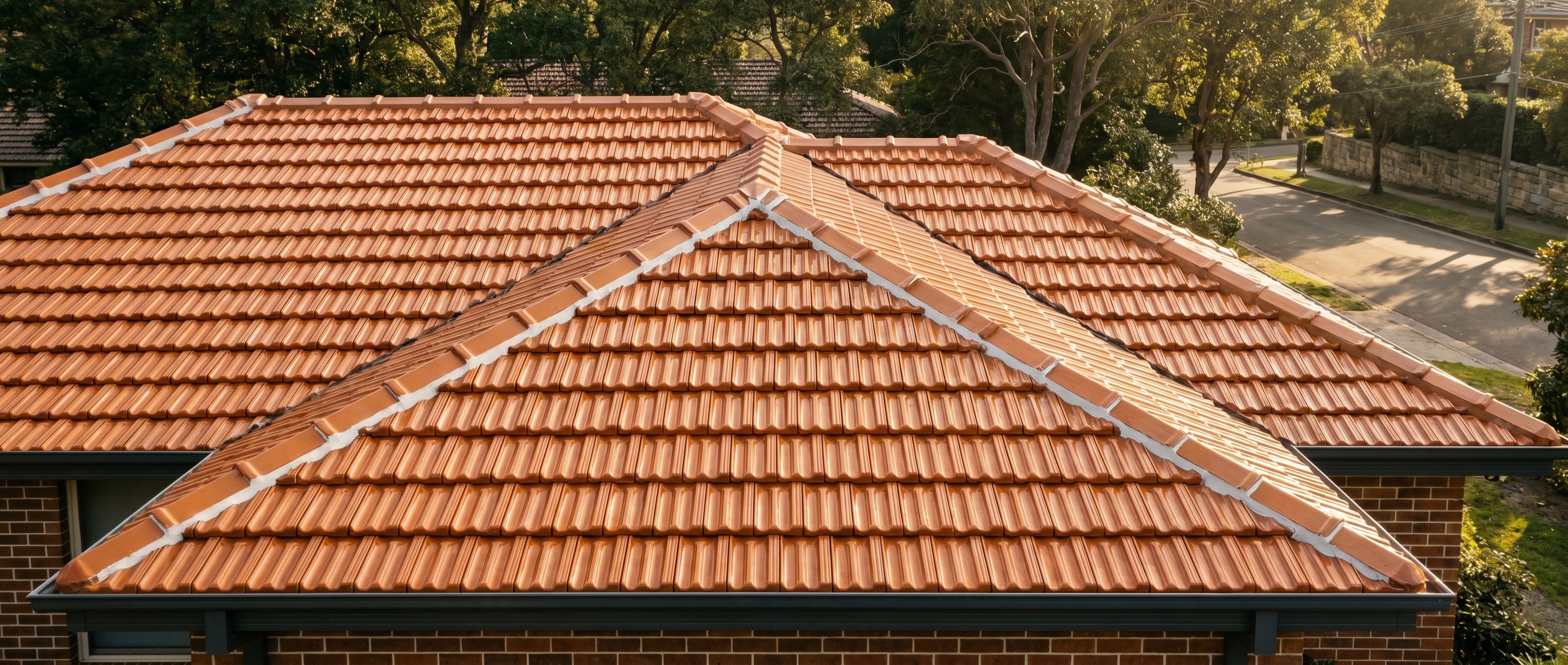
Hills District Tile Roof Restoration
Hills District Tile Roof Restoration
Is your tile roof showing its age but not yet ready for full replacement? Roof restoration could extend its life by 15 to 20 years — at a fraction of the cost of a new roof. Hills District Tile Roofing specialises in tile roof restoration across Castle Hill, Baulkham Hills, Cherrybrook, Pennant Hills, and surrounding suburbs. If your tiles are structurally sound but your mortar is crumbling and your coating has broken down, restoration is the smart, cost-effective answer.
Call (02) 5700 2003 for a free inspection and honest recommendation.
Our Tile Roof Restoration Services
A professional tile roof restoration is a three-stage process. Each stage needs to be done in the right order, with the right materials, to achieve a durable result. Here’s exactly what we do:
Stage 1: Re-Pointing Ridge Caps and Valleys
The mortar holding your ridge cap tiles, valley tiles, and flashings in place is almost certainly the oldest component on your roof. On Hills District homes built in the 1970s, 80s, and 90s, the original cement mortar is now 30–50 years old. It cracks, it crumbles, it allows water entry at the highest and most vulnerable points on your roof.
Re-pointing is the process of removing all failed mortar and replacing it with flexible polymer mortar. This is critical — we do not use traditional cement mortar on any re-pointing work. Cement mortar is rigid; it cracks again within 5 years due to thermal movement. Polymer mortar flexes with temperature changes and lasts 20+ years.
We inspect and photograph every mortar joint before re-pointing, so you have a documented record of the original condition.
Stage 2: High-Pressure Cleaning
Before any coating is applied, the entire tile surface must be thoroughly cleaned. Lichen, moss, algae, bird droppings, and general environmental contamination are all removed using professional-grade high-pressure equipment. This step is non-negotiable — applying coating over dirty or contaminated tiles creates adhesion failure and premature peeling.
High-pressure cleaning reveals the true condition of the tiles underneath — hairline cracks not visible through biological growth are identified at this stage, and individual damaged tiles are replaced before coating.
The cleaned tiles typically need 24–48 hours to dry fully before the coating stage begins.
Stage 3: Re-Coating with Membrane Sealer
A breathable membrane sealer is applied to all tile surfaces. This re-establishes the waterproofing performance of aged concrete tiles that have lost their original factory surface treatment. The membrane also refreshes the colour of faded tiles, giving your roof a near-new appearance.
Coating is applied in two coats (primer and top coat) using professional airless spray equipment for consistent coverage. For terracotta tiles, a penetrating sealer is used rather than a surface film coat — terracotta requires a different treatment to concrete.
Restoration vs Replacement — Repair or Install New Tiles?
This is the most important question in any restoration inquiry. Here’s our honest guide:
Restoration is appropriate when:
- Your tiles are structurally sound — no widespread cracking or disintegration
- Damage is limited to mortar, coating, and isolated broken tiles
- The roof is between 20 and 45 years old with good tile body condition
- You want to extend the life of the existing roof without the disruption of full replacement
- The home is not undergoing major structural renovation that would require tile removal anyway
Replacement is the better choice when:
- Widespread tile failure across multiple sections — cracked, chipped, or disintegrated tiles throughout
- Structural damage to battens, rafters, or roof framing that requires tile removal to address
- Sarking (the waterproofing membrane under tiles) has completely failed — sometimes discoverable only on internal inspection
- The roof has been poorly restored previously with incorrect materials and the coating is now failing or flaking
The honest answer: we tell you which category your roof falls into at the free inspection, and we don’t push restoration when replacement is the right call. There’s no benefit to us in selling you a restoration that fails in three years.
How Long Does Roof Restoration Last?
A quality restoration — done with correct materials and processes — will extend your tile roof’s life by 15 to 20 years. The key variables are:
- Tile condition prior to restoration — tiles with significant hairline fractures will deteriorate despite the best restoration work
- Mortar quality — polymer mortar lasts 20+ years; cement mortar will fail much sooner
- Coating system quality — premium membrane systems from suppliers like Nutech or Dulux Acratex outperform cheap single-coat products
- Application standards — correct surface preparation and two-coat application is essential
- Your roof’s exposure — a north-facing roof with direct sun and significant thermal cycling will work a coating harder than a sheltered south-facing pitch
We can give you a realistic longevity estimate based on your specific roof during the inspection.
How Much Does Tile Roof Restoration Cost in The Hills District?
A full tile roof restoration for a typical Hills District home costs between $3,000 and $8,000, depending on:
- Roof area — the primary cost driver; most Hills District homes range from 150 to 250sqm of tiled surface
- Extent of re-pointing required — more failed mortar means more re-pointing labour
- Number of broken tiles to replace before coating — each tile replacement adds material and labour cost
- Roof pitch and access — steeper and higher roofs cost more due to safety requirements
- Coating system specified — premium systems cost more but last longer
| Restoration Scope | Typical Price Range |
|---|---|
| Small roof (single storey, under 150sqm) | $3,000 – $5,000 |
| Average Hills District home (150–220sqm) | $4,500 – $6,500 |
| Larger home or two-storey (220sqm+) | $6,000 – $8,000+ |
All quotes are written and fixed-price — the figure we give you is what you pay.
Roof Restoration Contractors for Hills District Homes
The Hills District has a particularly high density of homes that are ideal candidates for roof restoration:
Cherrybrook and West Pennant Hills Established suburbs developed heavily in the 1970s and 80s. Many original terracotta tile roofs are now 40–50 years old. The tiles themselves are often in excellent structural condition — terracotta is extremely durable — but the original cement mortar has long since failed and the tiles have decades of biological growth. These are classic restoration candidates.
Castle Hill and Baulkham Hills Large stock of 1980s and 1990s homes with concrete tile roofs. Concrete tile coatings from this era are typically long exhausted — tiles are porous and faded. A quality restoration with re-pointing and re-coating is almost always cost-effective versus replacement for this era of home.
Pennant Hills and Carlingford Similar vintage to Cherrybrook, with significant original terracotta stock. We carry out substantial re-pointing work in this area specifically.
Kellyville and Rouse Hill Newer suburbs, but homes built in the early 2000s are now approaching the point where their first major maintenance restoration makes sense — particularly the re-pointing of concrete tile ridge caps laid with cement mortar that is now 20+ years old.
Suburbs We Cover
We carry out tile roof restoration across all of The Hills District:
- Castle Hill — concrete tile restoration very common, especially 1980s–1990s homes
- Baulkham Hills — mix of terracotta and concrete, full restoration service
- Cherrybrook — strong demand for original terracotta restoration and re-pointing
- West Pennant Hills — established large-block homes, terracotta dominant
- Pennant Hills — original 1970s–80s terracotta tile restoration
- Kellyville — early 2000s concrete tile re-pointing and restoration
- Rouse Hill — growing restoration demand as newer estates mature
- Norwest — residential restoration across the suburb
- Bella Vista — prestige restoration with careful tile and coating matching
- Glenhaven — larger acreage properties, experienced with complex rooflines
Call (02) 5700 2003 for a free inspection and written restoration quote.
Frequently Asked Questions
How do I know if I need restoration or replacement? The answer requires an inspection — you cannot reliably determine this from ground level. During our free inspection we assess tile integrity, mortar condition, sarking condition (where visible), and structural elements. We give you a written recommendation for restoration or replacement based on what we find — not based on which job we’d prefer to do.
How long does a full restoration take? Most Hills District home restorations take 3–5 days, depending on roof size and weather. Stage one (re-pointing) takes 1–2 days, the roof needs to dry before cleaning, high-pressure cleaning takes a day, and coating takes 1–2 days with drying time between coats. Weather is the variable — we won’t apply coating in wet or very humid conditions.
Do you use flexible polymer mortar? Yes, always. We do not use old-style cement mortar on any re-pointing work. Cement mortar is rigid and cracks within a few years due to the thermal movement of a tile roof in Sydney’s climate. Polymer mortar is flexible, UV-stable, and lasts 20+ years. This is not optional — it’s the correct specification for the work.
Will the re-coating change the look of my roof? Coating refreshes and revives the existing colour of your tiles but does not dramatically change the appearance. Your roof will look like a clean, well-maintained version of itself — not a different colour. If your concrete tiles are heavily faded, the coating will restore depth of colour. For terracotta, we use penetrating sealers that enhance the natural appearance without creating an artificial film. If you want a colour change, there are tinted coating options — discuss this with us at the quote stage.
Is restoration worth it on an older home? Yes — if the tiles themselves are structurally sound. Terracotta tiles from the 1970s and 80s are often in excellent condition despite surface weathering. Re-pointing and re-coating a sound set of original terracotta tiles is almost always better value than replacement. Concrete tiles from the same era need more careful assessment — some are in excellent condition, others have surface erosion that makes restoration less effective.
Ready to restore your tile roof?
Call (02) 5700 2003 or request a free inspection online. We’ll give you an honest written assessment — repair, restoration, or replacement — at no charge.
Hills District Tile Roofing — tile roof specialists across The Hills District. AS 2050 compliant. Licensed and insured.
Also see: Roof Re-Pointing — Hills District | Tile Roof Replacement — Hills District | Tile Roofing Castle Hill